A typical industrial construction site brings together dozens of trades, schedules and cultures: pipe and electrical fitters, welders, automation and instrumentation installers, insulators, surface treatment specialists, scaffolders and logistics professionals — often from different companies and different parts of the world. Keeping that whole machine running is anything but a given.
An industrial site is a complex network where a delay on one side can cascade through the entire chain. Ardor's Site Manager Tero Packalen has spent his career running these kinds of projects and knows what keeps a site moving.
“It all comes down to scheduling and talking to each other,” Tero sums up.
The weekly meeting: a simple but powerful tool
The central tool for day-to-day coordination is the weekly contractor meeting, where everyone working on the site gathers in the same room. No emails, no middlemen — things get sorted out face to face.
The meeting covers the week ahead and the weeks beyond it. That way every party knows not only their own situation, but what the crew next door is up to as well. Overlaps and dependencies surface before they have a chance to cause problems.
Visual schedules are used throughout, with work packages laid out clearly alongside their target man-hours.
On the ground, communication is fast and immediate. “If something is on your mind and needs sorting out, you just pick up the phone and ask,” Tero says. Every team also has a WhatsApp group for everyday updates, but the bigger questions are always handled by talking.
Mixed crews are a strength — and they need active leadership
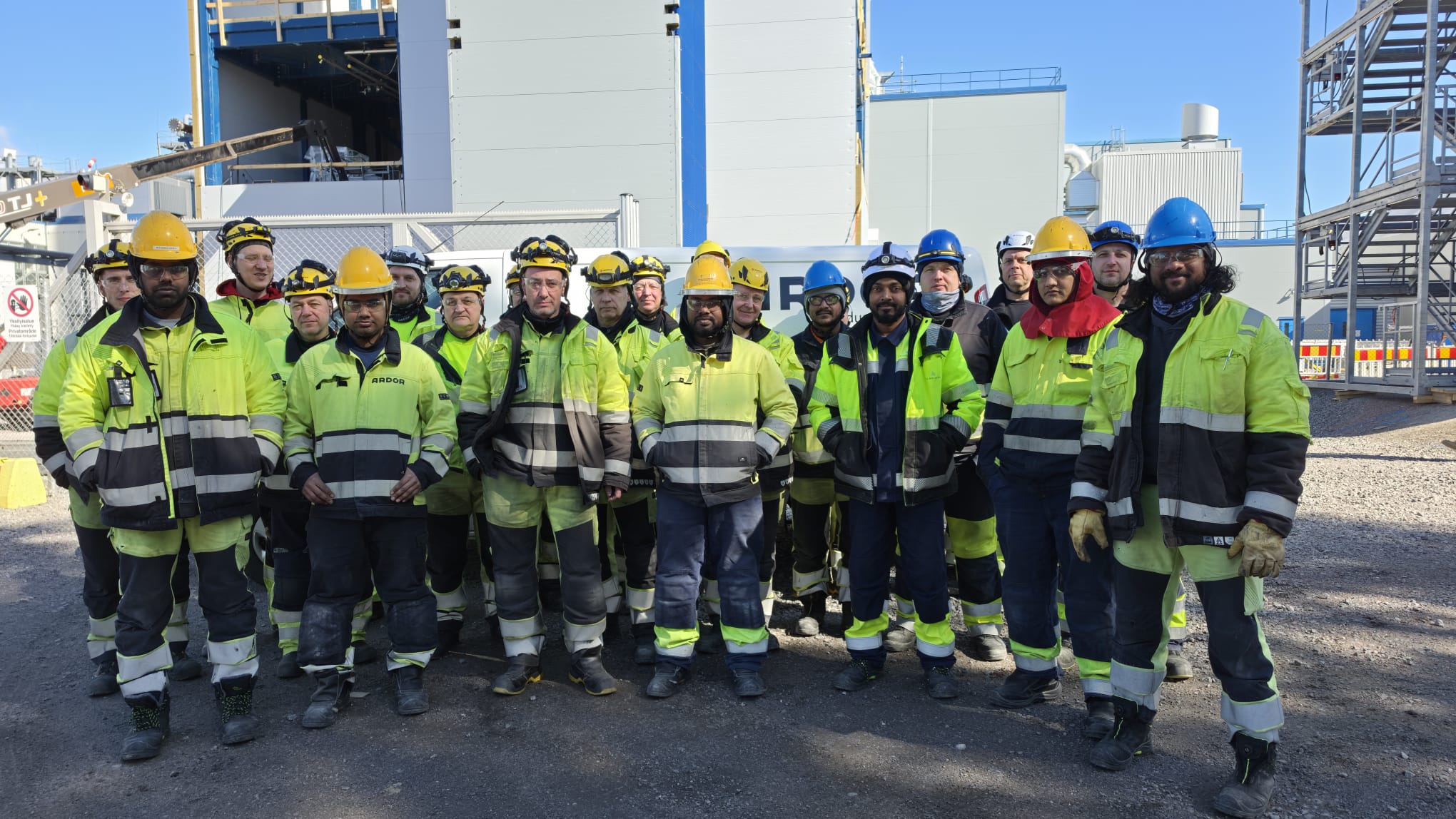
On any given day an Ardor site might have Indian, Bangladeshi, Ukrainian, Russian and Lithuanian fitters working side by side. Some are Ardor's own people, others come through staffing partners. On top of nationalities, the site brings together different companies and different trades, each with their own way of working and communicating.
Those different backgrounds bring skills and perspectives you'd never find within a single culture, but that richness doesn't realise itself automatically. It calls for paying closer attention — to your own work, and to what the crew next to you is doing.
Team-building starts with the basics
Workers have the tools and gear the job requires, and because site assignments run long, accommodation is arranged as well as the location allows on any given rotation.
The same goes for everyone, whether they're on Ardor's own payroll or working through a staffing partner. Tools, accommodation, downtime and rest — when those basics are right, people have the energy to perform, they engage, and they feel part of the crew.
Tero spends 70–80 percent of his working time in the field rather than the office. Leading up close means being present in a very concrete way: “Misunderstandings do happen on a site, but they get sorted out quickly, thoroughly and in good spirits. When you're in the same space, talking comes naturally,” he reflects.
Reacting fast keeps small frictions from eating away at site morale, and it's also what keeps the site safe for everyone.
Digital tools are an aid, not a cure-all
Ardor uses the Pipecloud modelling software in fabrication, and it has brought significant efficiency to the prefabrication workshop. On the site itself, digital tools support reporting, but for working drawings a large enough paper printout still beats any screen. The point isn't the medium, it's that the site has the right information, and that it flows quickly into the digital systems and from there to engineering and project management.
No secret ingredient
A site that works isn't built on anything mysterious. Scheduling, face-to-face conversation, presence on the ground, the basics looked after — combine those with a team drawn from different nationalities, companies and trades, and you get a site where everyone wants to succeed together.
—
Did you know piping can also be delivered as modules?
Process piping installation often sets the pace for the entire site. In traditional field installation, the completion of the piping is what opens the way for electricians, insulators and surface treatment crews.
Ardor can also deliver industrial piping as ready-made modules — piping, steel structures and equipment connected as one — leaving the site team to join the modules together, complete the connections and run pressure tests before commissioning.
Either way, the piping schedule determines when the other contractors can move forward. That position carries responsibility: staying on schedule is in the whole project's interest.